Case Study: Ethylene Glycol Toxicity

Alexander Civello
BSc (Hons), BVSc, MVetMed, FRCPath, DipACVP, MRCVS
Board Certified Anatomic Pathologist
History
A 2-year-old dog presents with anuric acute kidney injury, renal failure and uraemic encephalopathy. There is no history of access to toxins. Urine analysis reveals SG 1.009, pH 5, protein ++, glucose +, haemoglobin-RBC ++++. On urine sediment examination, there are large numbers of calcium oxalate monohydrate crystals and occasional epithelial cells.
A kidney is collected at post-mortem and submitted in formalin for histopathology.
Examination of the gross specimen in the lab
The anatomic pathologist working in the laboratory grossly examines the kidney. No focal lesions are detected externally or on the cut surfaces after sectioning. Several representative sections are processed for histology.
Histology

Figure 1 – The overall architecture of the kidney is preserved, with distinct cortex and medulla visible. There is no evidence of hydronephrosis since the pelvis is narrow and not dilated.

Figure 2 – Even at low magnification, in the cortex, large numbers of crystals are noted within tubules.

Figure 3 – At high magnification, the crystals are colourless to faintly yellow, arranged in sheaves, rosettes, or prisms. When viewed under polarised light, the crystals are birefringent. Observe the relatively healthy glomerulus on the right in this image.

Figure 4 – Large numbers of tubules in the cortex show necrosis, in the form of hypereosinophilic (red staining) cells, fragmentation and lysis of the nuclei. Compare the two necrotic tubules (red arrow) adjacent to a relatively healthy tubule (green arrow).
What is your histological diagnosis?
Acute tubular necrosis with intratubular calcium oxalate crystals. This is consistent with ethylene glycol toxicity.
Ethylene glycol toxicity
Although there is no known history of exposure, it is highly likely that this dog has ingested ethylene glycol. Ethylene glycol is the main ingredient in antifreeze. Low numbers of calcium oxalate crystals can be observed histologically in kidneys in chronic renal failure of various causes, but the large number of calcium oxalate crystals observed here together with the observation of acute tubular necrosis is virtually pathognomonic for ethylene glycol toxicity.
Antemortem diagnosis of ethylene glycol toxicity requires a combination of history of exposure (if known), clinical signs, blood biochemistry, urinalysis and potentially toxicology testing. Common clinical signs are ataxia, depression and vomiting. Common pathologic findings are high anion gap metabolic acidosis (due to unmeasured anions, which are the metabolites – oxalic acid and others), hyperglycaemia, azotaemia and calcium oxalate monohydrate crystals in the urine (see figure 5). Less common/specific findings are hyperphosphataemia, hypocalcaemia, poorly concentrated urine, glycosuria, proteinuria.
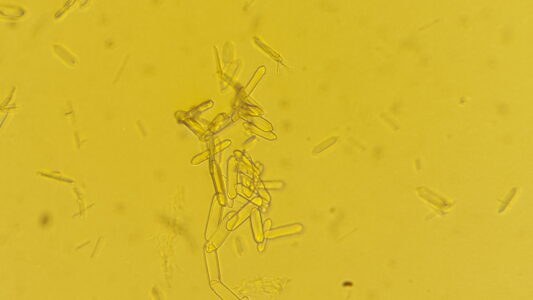
Figure 5 – This is the usual appearance of calcium oxalate monohydrate crystals in urine in cases of ethylene glycol toxicity, and when detected they should be considered pathologic. The crystals have a flat picket fence board-like shape. The crystals may also form spindles and dumbbell shapes. Crystalluria can be observed within 3 hours of ethylene glycol ingestion in cats and within 6 hours in dogs.
Toxicology testing at VPG
VPG offers toxicology testing for a wide range of toxic compounds, including ethylene glycol using a technique called gas chromatography-mass spectrometry (GC-MS). The test is useful in the clinical setting to confirm clinical suspicion of ethylene glycol toxicity. Blood and urine are recommended samples and the test can be performed on as little as 5 μL of either. For more information about toxicology at VPG please click on this link to visit our toxicology page https://thevpg.co.uk/toxicology/
References:
Amoroso L, Cocumelli C, Bruni G, Brozzi A, Tancredi F, Grifoni G, Mastromattei A, Meoli R, Di Guardo G, Eleni C. Ethylene glycol toxicity: a retrospective pathological study in cats. Vet Ital. 2017 Sep 30;53(3):251-254. doi: 10.12834/VetIt.1159.6409.2. PMID: 29152707.
Iqbal A, Glagola JJ, Nappe TM. Ethylene Glycol Toxicity. 2022 Sep 26. In: StatPearls [Internet]. Treasure Island (FL): StatPearls Publishing; 2025 Jan–. PMID: 30725694.